Sunday, 23 August 2015

Jean Philippe Arthur Dubuffet (31 July 1901 – 12 May 1985)


Jean Dubuffet
20070624 Dubuffet - Court les rues.JPG
Jean Philippe Arthur Dubuffet (31 July 1901 – 12 May 1985) was a French painter and sculptor. His idealistic approach to aesthetics embraced so called "low art" and eschewed traditional standards of beauty in favor of what he believed to be a more authentic and humanistic approach to image-making. He is perhaps best known for founding the art movement Art Brut, and for the collection of works—Collection de l'art brut—that this movement spawned. Dubuffet enjoyed a prolific art career, both in France and in America, and was featured in many exhibitions throughout his lifetime.
Dubuffet was born in Le Havre to a family of wholesale wine merchants who were part of the wealthy bourgeoisie.[1]He moved to Paris in 1918 to study painting at the Académie Julian, becoming close friends with the artists Juan GrisAndré Masson, and Fernand Léger. Six months later, upon finding academic training to be distasteful, he left the Académie to study independently.[2] During this time, Dubuffet developed many other interests, including music, poetry, and the study of ancient and modern languages.[2] Dubuffet also traveled to Italy and Brazil, and upon returning to Le Havre in 1925, he married for the first time and went on to start a small wine business in Paris.[2] He took up painting again in 1934 when he made a large series of portraits in which he emphasized the vogues in art history. But again he stopped, developing his wine business at Bercy during the German Occupation of France. Years later, in an autobiographical text, he boasted about having made substantial profits by supplying wine to the Wehrmacht.[1]
Dubuffet's art primarily features the resourceful exploitation of unorthodox materials. Many of Dubuffet's works are painted in oil paint using an impastothickened by materials such as sandtar and straw, giving the work an unusually textured surface.[9] Dubuffet was the first artist to use this type of thickened paste, called bitumen.[10]Additionally, in his earlier paintings, Dubuffet dismissed the concept of perspective in favor of a more direct, two-dimensional presentation of space. Instead, Dubuffet created the illusion of perspective by crudely overlapping objects within the picture plane. This method most directly contributed to the cramped effect of his works.
From 1962 he produced a series of works in which he limited himself to the colours red, white, black, and blue. Towards the end of the 1960s he turned increasingly to sculpture, producing works in polystyrene which he then painted with vinyl paint.

Saturday, 22 August 2015

Louise Élisabeth Vigée Le Brun (Marie Élisabeth Louise; 16 April 1755 – 30 March 1842)

Louise Élisabeth Vigée LeBrun
Self-portrait in a Straw Hat by Elisabeth-Louise Vigée-Lebrun.jpg
Louise Élisabeth Vigée Le Brun (Marie Élisabeth Louise; 16 April 1755 – 30 March 1842) born in Paris, also known as Madame Lebrun, was a prominent French painter.
Her artistic style is generally considered part of the aftermath of Rococo, while she often adopts a neoclassical style. Vigée Le Brun cannot be considered a pure Neoclassist, however, in that she creates mostly portraits in Neoclassical dress rather than the History painting. While serving as the portrait painter to Marie Antoinette, Vigée Le Brun works purely in Rococo in both her color and style choices.
Vigée Le Brun left a legacy of 660 portraits and 200 landscapes. In addition to private collections, her works may be found at major museums, such as the Hermitage MuseumLondon's National Gallery, and museums in continental Europe and the United States.


BiographyEdit


Born in Paris on April 16, 1755, Marie-Louise-Élisabeth Vigée was the daughter of a portraitist and fan painter, Louis Vigée, from whom she received her first instruction. Her mother, Jeanne (née Maissin) was a hairdresser. She was sent to live with relatives in Épernon until the age of 6 when she entered a convent where she remained for five years. Her father died when she was 12 years old. In 1768, her mother married a wealthy jeweler, Jacques-François Le Sèvre and shortly after, the family moved to the Rue Saint-Honoré, close to the Palais Royal. She was later patronized by the wealthy heiress Louise Marie Adélaïde de Bourbon, wife of Louis Philippe II, Duke of Orléans. During this period Louise Élisabeth benefited from the advice of Gabriel François DoyenJean-Baptiste GreuzeJoseph Vernet, and other masters of the period.
By the time she was in her early teens, Louise Élisabeth was painting portraits professionally. After her studio was seized for her practicing without a license, she applied to the Académie de Saint Luc, which unwittingly exhibited her works in their Salon. In 1774, she was made a member of the Académie. On January 11, 1776 she married Jean-Baptiste-Pierre Le Brun, a painter and art dealer. Vigée Le Brun began exhibiting her work at their home in Paris, the Hôtel de Lubert, and the Salons she held here supplied her with many new and important contacts.[1]Her husband's great-great-uncle was Charles Le Brun, the first Director of the French Academy under Louis XIV. Vigée-Le Brun painted portraits of many of the nobility of the day.
On 12 February 1780, Vigée-Le Brun gave birth to a daughter, Jeanne Julie Louise, whom she called "Julie".
In 1781 she and her husband toured Flanders and the Netherlands where seeing the works of the Flemish masters inspired her to try new techniques. There, she painted portraits of some of the nobility, including the Prince of Nassau. In 1787, she caused a minor public scandal with a self-portrait, exhibited the same year, in which she was shown smiling open-mouthed – in contravention of painting conventions going back to antiquity. The court gossip-sheet Mémoires secretscommented: ‘An affectation which artists, art-lovers and persons of taste have been united in condemning, and which finds no precedent among the Ancients, is that in smiling, [Madame Vigée-Lebrun] shows her teeth.’[2]

Thursday, 20 August 2015

Carle or Charles-André van Loo (15 February 1705 – 15 July 1765)

  • Edit
  • Watch this page

                                                         Charles-André van Loo

Carle or Charles-André van Loo (15 February 1705 – 15 July 1765) was a French subject painter, son of the painter Louis-Abraham van Loo, a younger brother of Jean-Baptiste van Loo and grandson of Jacob van Loo. He was the most famous member of a successful dynasty of painters of Dutchorigin. His oeuvre includes every category: religion, history painting, mythology, portraiture, allegory, and genre scenes.[1]
Charles-André van Loo, The Virgin, 1738
He was born in Nice, then part of the Duchy of Savoy. Van Loo followed his brother Jean-Baptiste to Turin, and then to Rome in 1712, where he studied under Benedetto Luti and the sculptor Pierre Legros. After leaving Italy in 1723, he worked in Paris, studied at the Académie Royale, where he gained first prize for drawing in 1723, and received the first prize for historical painting in 1727—as did his future rival François Boucher. After again visiting Turin in 1727, he was employed by king Victor Amadeus II of Sardinia, for whom he painted a series of subjects illustrative of Tasso. In 1734 he settled in Paris, and in 1735 became a member of the Académie Royale de Peinture et de Sculpture and rose rapidly in the hierarchy of the academy. Madame de Pompadour and the French court were thaking the artist under their patronage. He was decorated with the Order of Saint Michael and named First Painterto king Louis XV of France in 1762. He was a most successful court painter but his portraits as well as history paintings also enjoyed an enormous success throughout all Europe. He died in Paris on 15 July 1765.[2][3]

Wednesday, 19 August 2015

Jean François de Troy (January 27, 1679, Paris – January 26, 1752, Rome)

  • Edit
  • Watch this page

                                                            Jean François de Troy

Jean François de Troy (January 27, 1679, Paris – January 26, 1752, Rome) was a French Rococo painter and tapestry designer. He was one of a family of painters, being the son of the portrait painter François de Troy (1645–1730), under whom he first studied, and at whose expense he first went to Italyfrom 1699 to 1706, staying in Rome, but also visiting many north Italian cities
The Abduction of Europa, by Jean-François de Troy.
The successful career of de Troy was based initially on large historical and allegorical compositions, such as Time Unveiling Truth (1733, National Gallery, London), but he is now most highly regarded for his smaller (cabinet-sized) and more spirited scenes of elegant social life, painted in Paris between 1725 and 1738, when he went to Rome.[1] They are among the best of those that rode on the wave of Watteau's success—indeed The Alarm, or the Gouvernante Fidèle (1723, Victoria and Albert Museum, London, 1723) was attributed to Watteau in the 19th century. A versatile artist, he made these tableaux de modes famous, while also painting histories and mythologiesin a colourful and fluent manner which owed something to both Veronese and Peter Paul Rubens.
He undertook commissions for Versailles and Fontainebleau between 1724 and 1737, and designed two sets of tapestries for the Gobelins, each of seven subjects, the Histoire d'Esther(1737–40) and the Histoire de Jason(1743–46).
In 1738 he was appointed Director of the French Academy in Rome and spent the rest of his life there. He was also elected as an honorary member of the Roman Academy of St Luke, and subsequently appointed briefly as director in 1744.[2] De Troy's wife died prematurely, and he lost all of his seven children. Jean François de Troy died on January 26, 1752 in Rome.

Tuesday, 18 August 2015

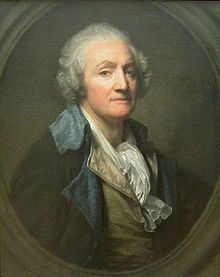
Jean-Baptiste Greuze (21 August 1725 – 4 March 1805)


  • Edit
  • Watch this page

Jean-Baptiste Greuze

"Greuze" redirects here. For the French actress, see Lillian Greuze.
Jean-Baptiste Greuze
Jean-Baptiste Greuze Self Portrait.jpg

Early lifeEdit

He was born at TournusBurgundy. He is generally said to have formed his own talent; this is, however, true only in the most limited sense, for at an early age his inclinations, though thwarted by his father, were encouraged by a Lyonnese artist named Grandon, or Grondom, who enjoyed during his lifetime considerable reputation as a portrait-painter. Grandon not only persuaded the father of Greuze to give way to his son's wishes, and permit the lad to accompany him as his pupil to Lyon, but, when at a later date he-himself left Lyon for Paris – where his son-in-law Grétry the celebrated composer enjoyed the height of favour – Grandon carried young Greuze with him.[1]
Settled in Paris, Greuze worked from the living model in the school of the Royal Academy, but did not attract the attention of his teachers; and when he produced his first picture, "Le Père de famille expliquant la Bible a ses enfants," considerable doubt was felt and shown as to his share in its production. By other and more remarkable works of the same class Greuze soon established his claims beyond contest, and won for himself the notice and support of the well-known connoisseur La Live de Jully, the brother-in-law of Madame d'Epinay. In 1755 Greuze exhibited his "Aveugle trompé," upon which, presented by Pigalle the sculptor, he was immediately agréé by the Academy.[1]
The Guitarist (1757), National Museum in Warsaw.
Towards the close of the same year he left France for Italy, in company with the Abbé Louis Gougenot, who had deserted from the magistrature – although he had obtained the post of conseiller au Châtelet in order to take the petit collet. Gougenot had some acquaintance with the arts, and was highly valued by the Academicians, who, during his journey with Greuze, elected him an honorary member of their body on account of his studies in mythology and allegory; his acquirements in these respects are said to have been largely utilized by them, but to Greuze they were of doubtful advantage, and he lost rather than gained by this visit to Italy in Gougenot's company. He had undertaken it probably in order to silence those who taxed him with ignorance of great models of style, but the Italian subjects which formed the entirety of his contributions to the Salon of 1757 showed that he had been put on a false track, and he speedily returned to the source of his first inspiration.[1]

Relations with the AcademyEdit

In 1759, 1761 ("L'accordée de village", Louvre), and 1763 Greuze exhibited with ever-increasing success; in 1765 he reached the zenith of his powers and reputation. In that year he was represented with no less than thirteen works, amongst which may be cited "La Jeune Fille qui pleure son oiseau mort", "La Bonne Mère", "Le Mauvais fils puni" (Louvre) and "La Malediction paternelle" (Louvre). The Academy took occasion to press Greuze for his diploma picture, the execution of which had been long delayed, and forbade him to exhibit on their walls until he had complied with their regulations. "J'ai vu la lettre," says Diderot, "qui est un modèle d'honnêteté et d'estime; j'ai vu la réponse de Greuze, qui est un modèle de vanité et d'impertinence: il fallait appuyer cela d'un chef-d'œuvre, et c'est ce que Greuze n'a pas fait." (I have read the letter, which is a model of honesty and reverence; I have seen Greuze's response, which is a model of vanity and impertinence: he should have backed it up with a masterpiece, and that's precisely what he didn't do.)[1]
The White Hat, 1780
Greuze wished to be received as a historical painter, and produced a work which he intended to vindicate his right to despise his qualifications as a peintre de genre. This unfortunate canvas "Sévère et Caracalla" (Louvre) was exhibited in 1769 side by side with Greuze's portrait of "Jeaurat" (Louvre) and his admirable "Petite Fille au chien noir". The Academicians received their new member with all due honours, but at the close of the ceremonies the Director addressed Greuze in these words "Monsieur, l'Académie vous a reçu, mais c'est comme peintre de genre; elle a eu égard à vos anciennes productions, qui sont excellentes, et elle a fermé les yeux sur celle-ci, qui n'est digne ni d'elle ni de vous." (Sir, the Academy has accepted you, but only as peintre de genre; the Academy has respect for your former productions, which are excellent, but she has shut her eyes to this one, which is unworthy, both of her and of you yourself.) Greuze, greatly incensed, quarrelled with his confreres, and ceased to exhibit until, in 1804, the Revolution had thrown open the doors of the Academy to all the world.[1]
Portrait of Benjamin Franklin, 1777
In the following year, on 4 March 1805, he died in the Louvre in great poverty. He had been in receipt of considerable wealth, which he had dissipated by extravagance and bad management (as well as embezzlement by his wife), so that during his closing years he was forced even to solicit commissions which his enfeebled powers no longer enabled him to carry out with success. "At the funeral of the long neglected old man, a young woman deeply veiled and overcome with emotion plainly visible through her veil, laid upon the coffin, just before its removal, a bouquet of immortelles and withdrew to her devotions. Around the stem was a paper inscribed: